Ten years after his debut, Sonic turned up somewhere nobody in 1991 would have believed: a Nintendo machine. Four heroes, seven Emeralds and a trip to the Moon, all in your pocket.
Released20 Dec 2001 (JP) · Feb 2002 (US) · 8 Mar 2002 (EU)
DeveloperDimps and Sonic Team
PublisherSega; THQ in North America
ZonesSix, plus X-Zone and a secret Moon Zone
PlayableSonic, Tails, Knuckles, Amy
Sales1.21 million in the US
Title
Sonic Advance Japan: ソニック アドバンス; working title Sonic the Hedgehog Advance
Platforms
Game Boy Advance; Nokia N-Gage (as SonicN, 2003); mobile versions by Gameloft and an Android version by Sega (2011)
Developer
Dimps, with Sonic Team
Publisher
Sega; co-published by THQ in North America; Infogrames handled European marketing and distribution, and our original page credits Sega Europe
Producer
Yuji Naka (Sonic Team); Hiroshi Matsumoto (Dimps)
Director
Akinori Nishiyama
Art director
Yuji Uekawa
Technical director
Takahiro Hamano
Sound
Wave Master: Tatsuyuki Maeda, Yutaka Minobe; Masato Nakamura credited for the reworked Mega Drive tunes
Players
1–4 (multiplayer by Game Link Cable)
Released (Japan)
20 December 2001 (¥5,800); budget reissue 17 June 2004 (¥3,800)
Released (North America)
February 2002 (US$39.99). Sega Retro gives 5 February, Wikipedia 4 February and our original page 3 February
Sonic Advance is the game that came to symbolise the end of the console war. For a decade Sonic had been Sega’s answer to Mario, but after the Dreamcast struggled Sega became a software publisher, and its tenth-anniversary Sonic platformer launched on Nintendo’s Game Boy Advance in December 2001, on the same day Sonic Adventure 2: Battle reached the GameCube in Japan.
It plays like a love letter to the Mega Drive years, with loops, Special Stages, signposts and animal capsules, built by Dimps, a new studio some of whose staff had worked on Sonic Pocket Adventure, with Sonic Team alongside. The modern touches came from the Dreamcast games: Yuji Uekawa’s sleeker character designs, rail grinding and a Tiny Chao Garden you could link up with the GameCube.
Four characters are playable, each with moves lifted from Sonic Adventure, and Amy Rose makes her debut as a playable heroine in a classic-style 2D Sonic. Critics loved its looks and its feel, grumbled that it was short, and buyers turned it into one of the Game Boy Advance’s biggest sellers.
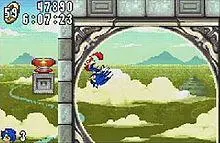
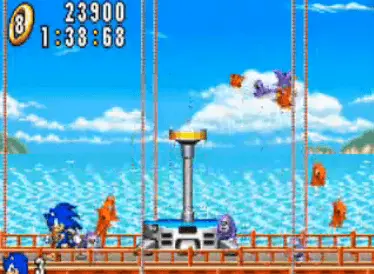
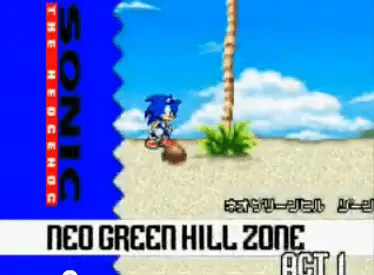
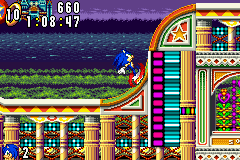
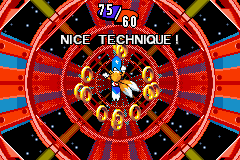
Neo Green Hill, the first zone.Casino Paradise.A Special Stage.
I will gain infinite power, once the 7 Chaos Emeralds are collected
Eggman’s boast from the prologue of the Japanese manual sums up the plot. The booklet sets the scene in a few lines: the doctor is turning animals into robots to build his empire, and Sonic is joined by Tails, Knuckles and Amy to stop him.
— Official description: Sega, Sonic Advance Japanese instruction manual (2001), prologue, in the English translation published by Sonic Retro. One line quoted; the rest summarised.
Quick Answers
The short answers, with the detail further down the page.
When did Sonic Advance come out?
In Japan on 20 December 2001, in North America in early February 2002 and in Europe on 8 March 2002, all on the Game Boy Advance. More →
Was it the first Sonic game on a Nintendo console?
Yes, jointly. It came out in Japan on the same day as Sonic Adventure 2: Battle for the GameCube, after Sega stopped making its own hardware. More →
Who made Sonic Advance?
Dimps, a new studio with ex-Neo Geo Pocket staff, working with Sonic Team. Yuji Naka produced it and Akinori Nishiyama directed. More →
Who can you play as?
Sonic, Tails, Knuckles and Amy, each with their own moves and save file. A code lets Tails follow Sonic as a partner, Sonic 2 style. More →
How do you reach the Special Stages?
Find the Special Spring hidden in each zone (Ice Mountain has two). Clear the stage to win one of the seven Chaos Emeralds, which all four characters share. More →
How do you unlock the Moon Zone?
Collect all seven Emeralds and clear the X-Zone with all four characters, then clear it once more as Sonic. Super Sonic takes on Eggman on the Moon. More →
What is the Tiny Chao Garden?
A Chao-raising mini-game built into the cartridge and open from the start. Rings you earn in the main game can be spent there, and Chao can travel to and from Sonic Adventure 2: Battle on the GameCube. More →
How well did it sell?
Around 1.21 million copies were sold in the US alone, which puts it among the Game Boy Advance’s top sellers there. More →
Can I play it today?
Outside Japan, the original cartridge is the only official way. Japan also got a Wii U Virtual Console release in 2015. More →
Plot / Story
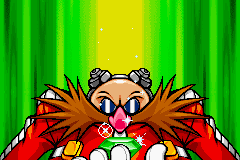
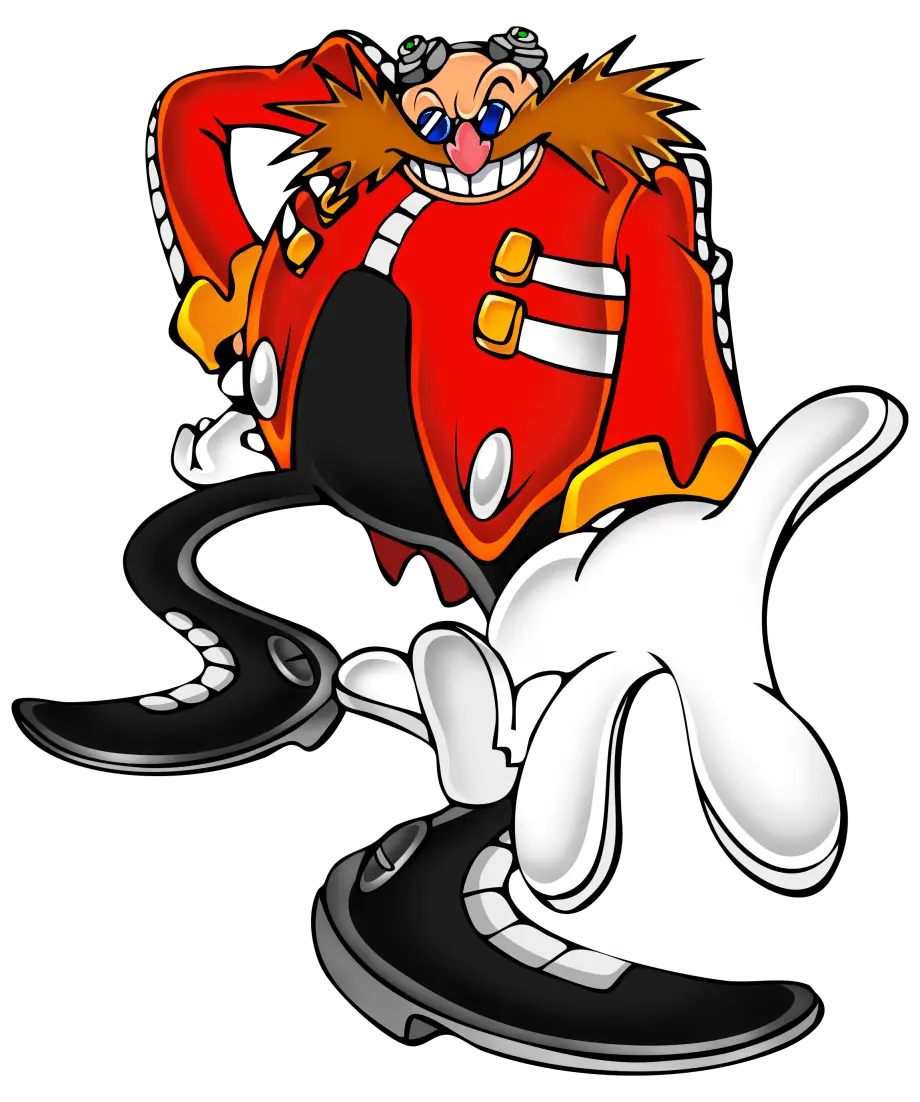
Dr. Eggman in Sega’s artwork for the game.
Sonic Advance keeps its story lean. Eggman wants the seven Chaos Emeralds and the infinite power that comes with them, and he is turning the world’s animals into robots to build an empire while he looks for them. The Japanese manual casts the robots as Sonic’s friends being used against him, which is all the reason Sonic, Tails, Knuckles and Amy need.
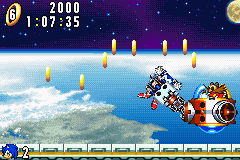
The chase climbs as it goes. From the beaches of Neo Green Hill the heroes work through Eggman’s factories, a neon casino, an ice cave and the ruins of Angel Island, then discover the doctor’s Egg Rocket on its launch pad. Ride it to the top and it delivers you to Cosmic Angel, a space station, and finally to the X-Zone, an orbiting platform where Eggman brings back his greatest hits.
Two endings and a trip to the Moon
Beat Egg X with anyone but a fully powered Sonic and you get the short ending: the X-Zone blows up, your hero falls back to Earth and is caught in mid-air by a friend flying the Tornado.
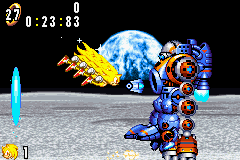
The real ending takes work. Win all seven Emeralds, clear the X-Zone with every character, then clear it again as Sonic: Eggman flees to the Moon, Sonic turns super and follows him for a last fight against the Super Egg Robot, with his ring count ticking down all the while. A few days later Tails goes looking for his missing friend and spots him streaking back from the Moon.
The X-Zone.Egg X.Super Sonic on the Moon.
Zones in Sonic Advance
Six zones. The first five have two acts each, with a signpost at the end of Act 1 and a boss and an animal capsule at the end of Act 2; the sixth, Egg Rocket and Cosmic Angel, is a pair of single acts. Then come the X-Zone and, for the dedicated, the Moon.
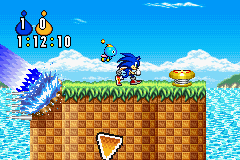
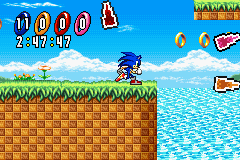
Neo Green Hill ZoneActs 1–2 · boss: Egg Hammer TankA beach full of umbrellas and deckchairs, then a downhill road packed with speed boosters. The only zone with no bottomless pits.
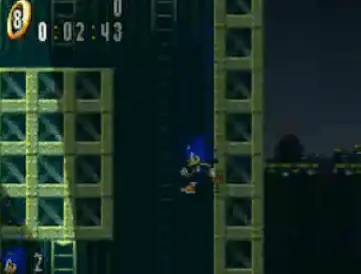
Secret Base ZoneActs 1–2 · boss: Egg PressAn Eggman factory with ziplines, hooks, pressurised pipes and vats of molten metal, owing a lot to Sonic 2’s Metropolis.
Casino Paradise ZoneActs 1–2 · boss: Egg BallNeon, flippers and fireworks, in the tradition of Casino Night. The letters spelling SEGA and SONIC are only solid while they are lit.
Ice Mountain ZoneActs 1–2 · boss: Egg SpiderSnow on top and long stretches underwater below. Air lasts 18 seconds, with no warning chime until the final countdown.
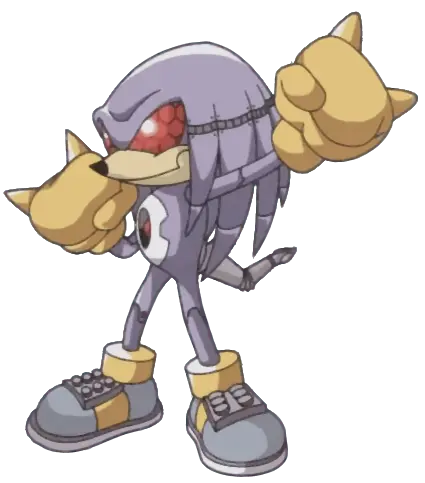
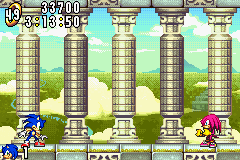
Angel Island ZoneActs 1–2 · boss: Mecha KnucklesNamed after Sonic 3’s jungle but closer to Sky Sanctuary: overgrown ruins, bouncy clouds and old machines you power by running on them.
Egg Rocket ZoneOne act · a race against the clockBoard the rocket and a five-minute timer starts. Reach each stage before it separates and the clock resets, three times over.
Cosmic Angel ZoneOne act · boss: Egg SnakeThe rocket’s destination, a space station that flips gravity and throws more pits and Badniks at you than anywhere else. The hardest stage in the game.
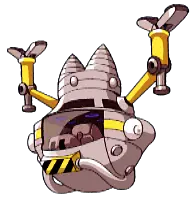
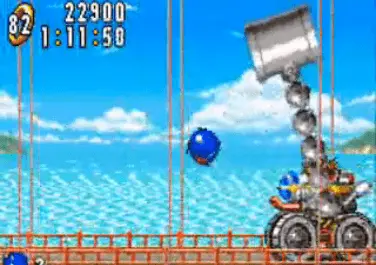
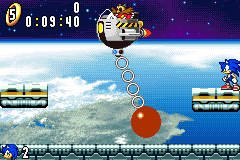
X-ZoneFinal zone · three bossesAn orbital platform built for a boss rush, like Sonic 1’s Final Zone: two remixed classics (the Green Hill wrecking ball and Sonic 2’s drill car), then the new Egg X.
The Moon ZoneSecret · boss: Super Egg RobotSuper Sonic only, starting with 50 rings and losing one a second.
The Special Stages are reached through Special Springs hidden in each zone: two in Ice Mountain, one everywhere else.
Sonic Adventure 2: BattleGameCube · 2001Released alongside it in Japan, and linked to it by cable: Chao can be passed between the GameCube game and the Tiny Chao Garden on the cartridge.
SonicNNokia N-Gage · 2003A port for Nokia’s phone-console. Reviewers disliked its choppy frame rate and tall screen, and the multiplayer modes were cut.
Mobile versionsGameloft · Sega · 2011Gameloft made a cut-down phone version with four zones, and Sega released an Android version in Japan.
Strategy guidesJapanJapanese publishers produced several guidebooks, including one covering both Sonic Advance and Sonic Adventure 2: Battle.
Characters
Four playable heroes, each with moves taken from Sonic Adventure and each with a save file of their own.
Character
Who they are
In this game
Stats & abilities
Sonic the HedgehogPlayable hero
Sega’s blue mascot, celebrating ten years in 2001 and drawn in Yuji Uekawa’s lankier modern style.
The fastest of the four, and the only one who can reach the true ending on the Moon.
Spin Attack and Spin Dash
Insta-Shield-style double spin in mid-air
Air dash: tap the direction twice after jumping
Somersault, skid attack and backflip with B
Super Sonic in the Moon Zone
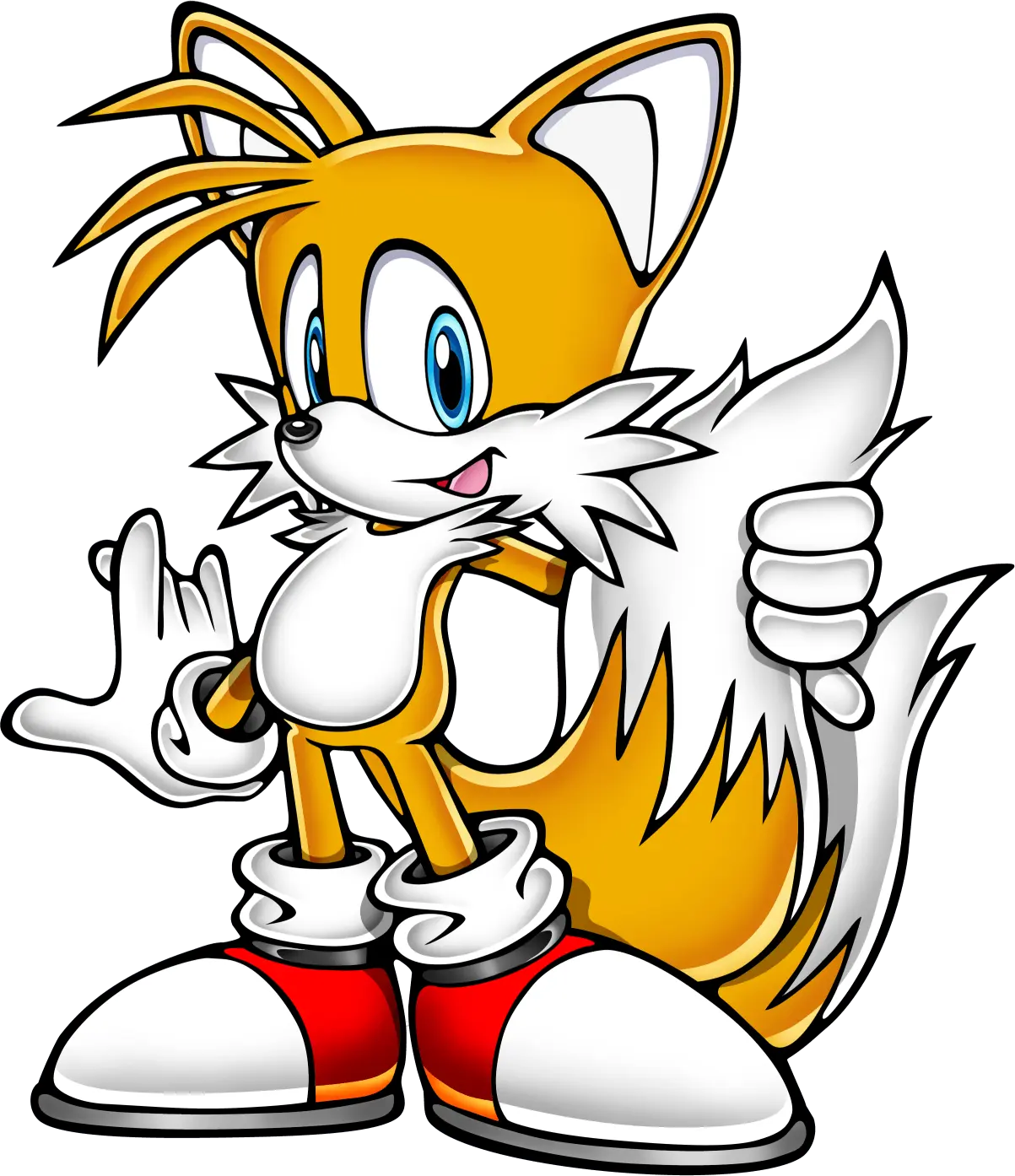
Miles “Tails” ProwerPlayable
Sonic’s two-tailed best friend, a mechanical whizz.
The easy way through: he can fly over trouble and swim underwater.
Flies or swims for up to 8 seconds
Tail swipe with B
Can follow Sonic as a partner with a code
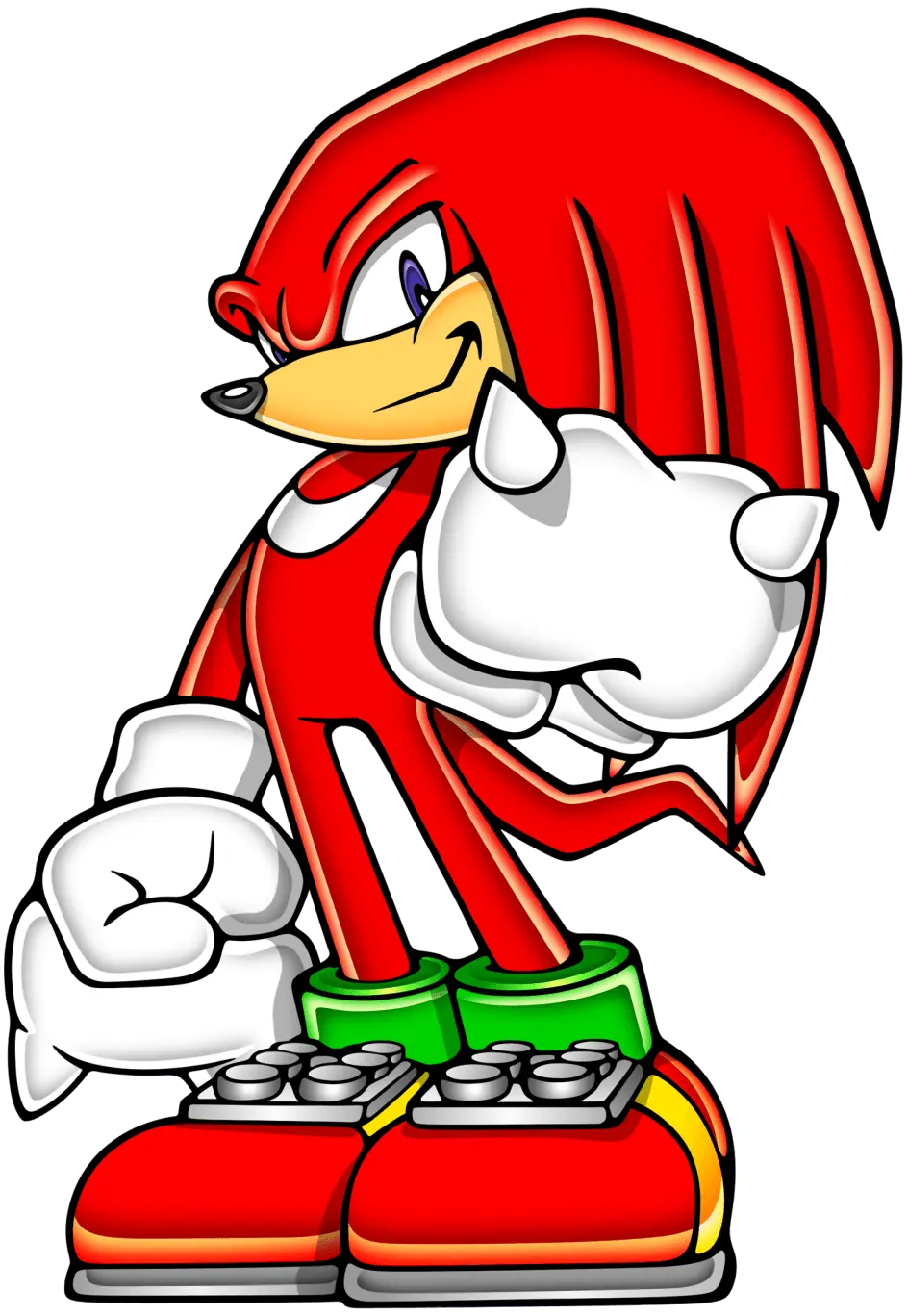
Knuckles the EchidnaPlayable
Guardian of the Master Emerald and Sonic’s sometime rival.
The explorer, gliding and climbing into places the others cannot reach.
Glide and climb walls
Floats to the surface in water
Punch, double punch and uppercut
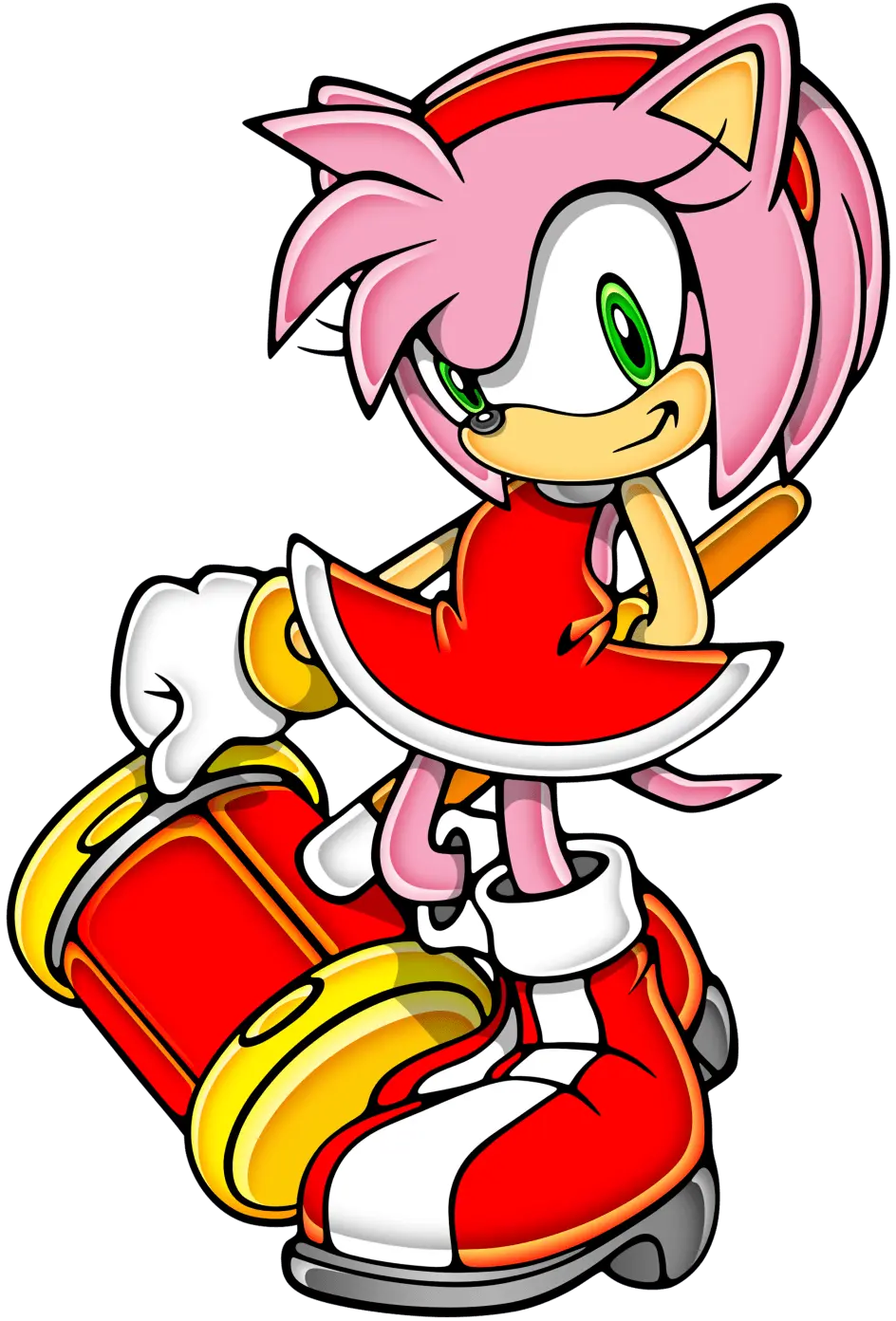
Amy RosePlayable for the first time in a classic-style 2D Sonic
Sonic’s self-declared girlfriend, armed with her Piko Piko Hammer.
The challenge character. She does not spin when she jumps, so she is easier to hurt, and her hammer does the work instead.
Giant steps instead of a Spin Dash
Hammer swing, hammer jump and hammer whirl
Hits springs with her hammer for a super-high jump
Dr. EggmanThe villain
Sega’s evil genius, still out to rule the world.
Turns animals into Badniks, chases the seven Emeralds and builds the Egg Rocket.
A boss machine for every zone
X-Zone boss rush
Super Egg Robot on the Moon
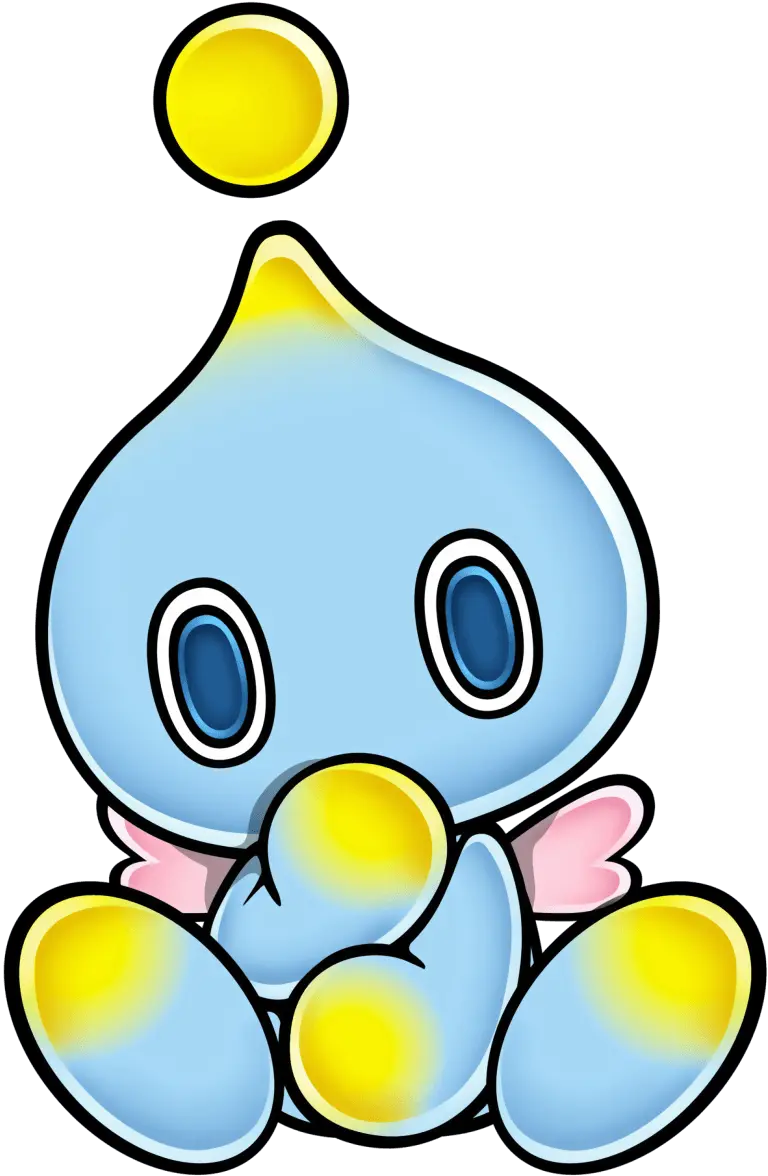
ChaoTiny Chao Garden
The pet creatures from Sonic Adventure.
Live in the Tiny Chao Garden, a mini-game open from the start, where rings earned in the main game carry over; they also star in the Chao Hunt multiplayer mode.
Can travel to and from Sonic Adventure 2: Battle on the GameCube by link cable.
Bosses
One machine per zone, then a boss rush. The pictures are Sega’s artwork from our original gallery.
Egg Hammer TankNeo Green HillEggman’s opening machine.
Egg PressSecret BaseFought among the factory machinery.
Egg BallCasino ParadiseA casino-themed machine.
Egg SpiderIce MountainWaits at the end of the ice caves.
Mecha KnucklesAngel IslandA robot Knuckles.
Egg SnakeCosmic AngelThe space station’s guardian.
Egg XX-ZoneThe new machine at the end of the boss rush, after two remixed classics.
Super Egg RobotThe MoonThe true final boss, fought by Super Sonic.
The people who made it
Credits from the game, as listed by Sega Retro.
Yuji NakaProducer · Sonic TeamSonic’s original programmer, producing the tenth-anniversary game.
Akinori NishiyamaDirectorDirected the game.
Yuji UekawaArt directorThe designer behind the Sonic Adventure-era look of the characters.
Hiroshi MatsumotoProducer · DimpsDimps’ producer, with Koichi Sakita as line producer.
Tatsuyuki Maeda, Yutaka MinobeSound · Wave MasterMade the music; Masato Nakamura is credited for the reworked Mega Drive themes.
Our original page had no history section, so this one is new, built from Wikipedia’s cited history, Sonic Retro’s prototype notes and Sega Retro’s release data.
From rival to Nintendo partner
In January 2001, with the Dreamcast losing money, Sega announced it would leave the hardware business and publish for other machines, with Sony’s PlayStation 2 and Nintendo’s Game Boy Advance near the top of the list. A handheld Sonic for the series’ tenth birthday was one of the first projects, and Sega unveiled it with two other GBA games on 30 January 2001.
Sonic Team came up with the game but did not have enough people who knew the GBA hardware, so it brought in Dimps. The new studio, backed by Sega, Sony and Bandai, included developers from the Neo Geo Pocket Color, some of whom had worked on Sonic Pocket Adventure. Sonic Advance was its first Sonic, and far from its last.
Old rules, new looks
The team went back to the Mega Drive formula, which Yuji Naka found refreshing, but borrowed freely from the Dreamcast games: Uekawa’s character designs, grinding on rails and Adventure-style moves for each hero. The Visual Memory Unit mini-games of the Dreamcast era turned into the Tiny Chao Garden, which put Sonic Advance among the earliest games to connect the GBA and the GameCube by cable.
Sonic the Hedgehog Advance at E3
Neo Green Hill’s boss.
Still called Sonic the Hedgehog Advance, the game was shown at E3 in May 2001 only as a short video of an early Neo Green Hill. The screenshots released with it show an unfinished status bar, set lower and with a chunkier ring and a different font. Playable demos followed later that year at Space World, Nintendo’s own show, and at the Tokyo Game Show.
Release
Sega published the game in Japan on 20 December 2001. THQ co-published it in North America in early February 2002 at US$39.99, and Europe followed on 8 March, with Infogrames looking after marketing and distribution. The finished cartridge was revised once, in a Japan-only version 1.1 that fixed a bug in the Tiny Chao Garden.
Firsts: what this game introduced
A game of milestones, for Sonic and for Sega.
1Sonic on NintendoWith Sonic Adventure 2: Battle, released the same day in Japan, the first Sonic game on a Nintendo platform.
2Dimps’ first SonicThe start of a long partnership that went on to give us the other Advance games and Sonic Rush.
3Playable AmyAmy’s first playable role in a classic-style 2D Sonic.
4Grinding in 2DThe first 2D Sonic where you can grind on rails, a Sonic Adventure 2 idea.
5Tiny Chao GardenOne of the first games to talk to the GameCube by link cable.
6Last of the signpostsThe last Sonic game to end its acts with signposts and animal capsules until Sonic the Hedgehog 4 in 2010.
Cheats & secrets
Our original Sonic Advance page had no cheats section, so this is new, checked against Sonic Retro’s hidden-content notes.
Tails as Sonic’s partner
Highlight Sonic when choosing a character and press Up, Right, Down, Right, L, Right, R, Right, A. A ring chime confirms it, and Tails follows Sonic through the game as he did on the Mega Drive.
Everything unlocked
If the game cannot find its save chip, it unlocks all of its content. The same goes for the other Advance games.
Codes checked against Sonic Retro, November 2026.
Glitches, exploits and oddities
Sonic Advance is polished, but Sonic Retro has found a few cracks, mostly in the game’s stranger corners.
Upside-down Knuckles
Cosmic Angel, where gravity flips.Screenshot via Sonic Retro
Egg Rocket and Cosmic Angel both flip gravity in places, and Knuckles can exploit the switch points. Glide into one at the right moment and he stays upside down where he should not be; climb down through a corner and he can fall straight through the wall.
Solid ground that is not
Speedrunners know this one: as Knuckles in Angel Island Act 1, a well-timed attack beside a loop drops him straight through the level. It works in Neo Green Hill Act 1 and Secret Base Act 2 as well. Crouch next to certain loops facing away from them and attack with B while the camera is still moving, and the map stops being solid. Tails cannot do it, because his tail swipe does not carry him forward.
Tails causes trouble
With the partner code on, Tails can land the final blow on Egg X while it holds Sonic, freezing the game. Even when things go right, he sneaks back onto the results screen after the X-Zone, where nothing else is supposed to be visible.
The Chao Garden bug
Erase your save from the options menu and rings no longer carry over to the Tiny Chao Garden. Japan’s version 1.1 fixed it.
Oddities
Win an extra life on the results screen and its jingle never plays. And if you pull the cartridge out mid-game and push it back in, the GBA can boot straight into an empty multiplayer screen.
Videos & media
A complete run of the game, and a look at how it holds up today.
A full playthrough from the World of Longplays archive.
A short review from the retro games channel SNES drunk.
Trivia & facts
Several menu and boss tunes are remixes from the Mega Drive games: the options screen uses Sonic 1’s Scrap Brain, the player data screen Star Light, and the first two X-Zone bosses fight to Sonic 1 and Sonic 2’s boss themes.
Egg X, the new boss waiting after them.The X-Zone brings back two Mega Drive bosses: the wrecking-ball Egg Mobile from Sonic 1’s Green Hill and the drill car from Sonic 2’s Emerald Hill.
Each character keeps a separate save file, but the Chaos Emeralds are shared.
Neo Green Hill is the only zone without a single bottomless pit.
By Sonic Retro’s count, no other handheld Sonic is confirmed to have passed a million sales in a single region.
Media & artwork
Box art, artwork and screenshots, from Sonic Scene’s own galleries and Sonic Retro. Select any image to view it larger.
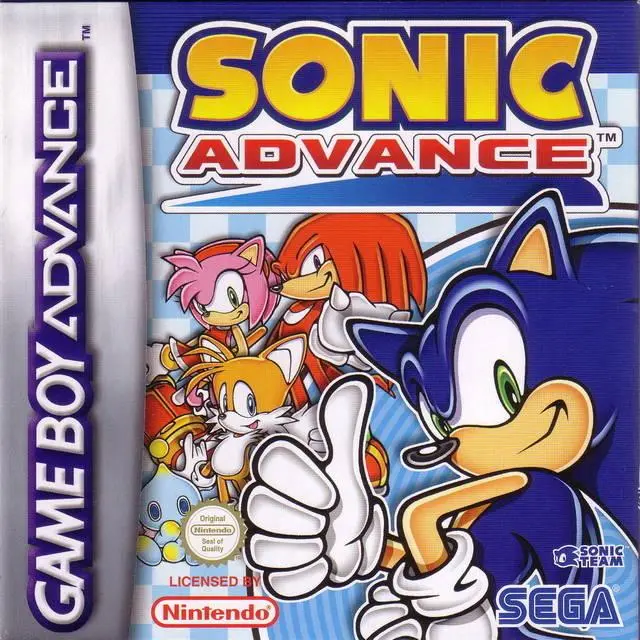
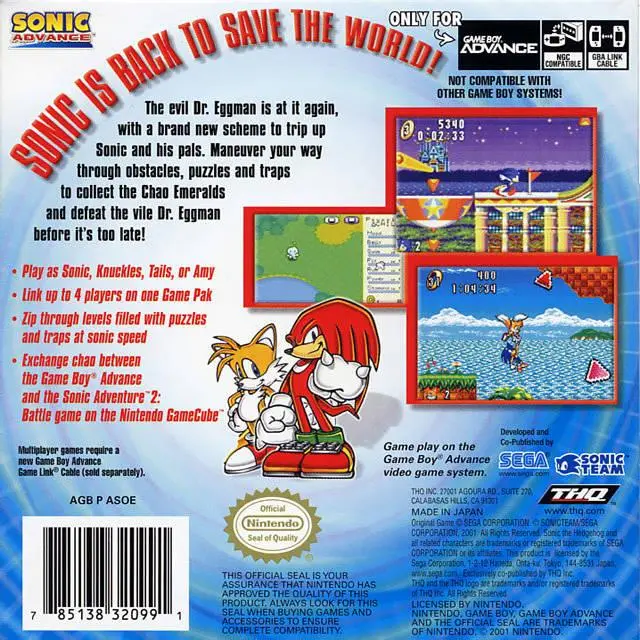
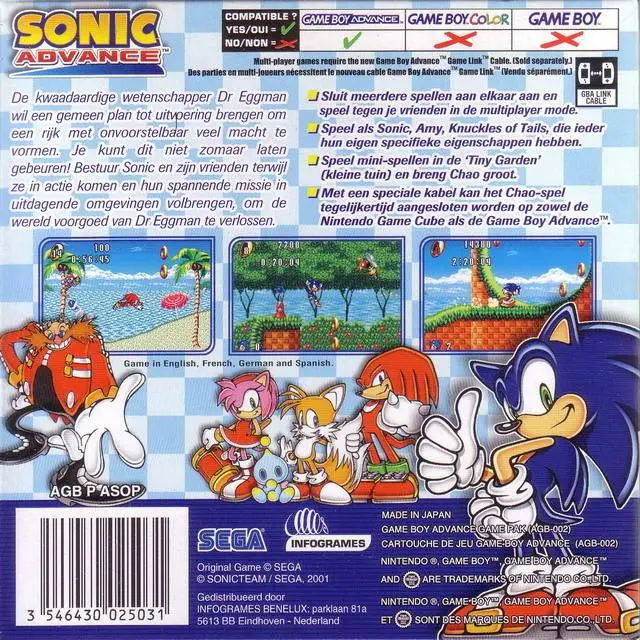
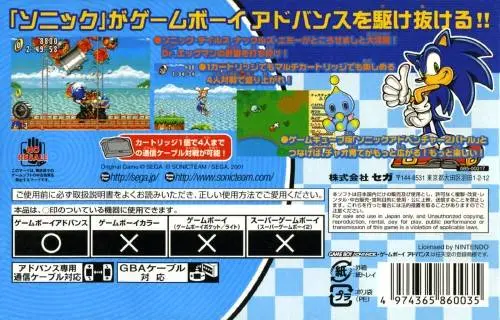
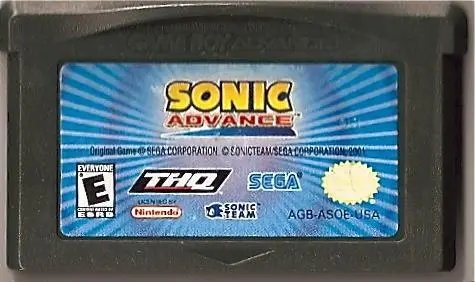
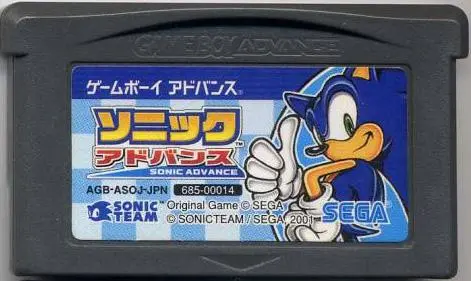
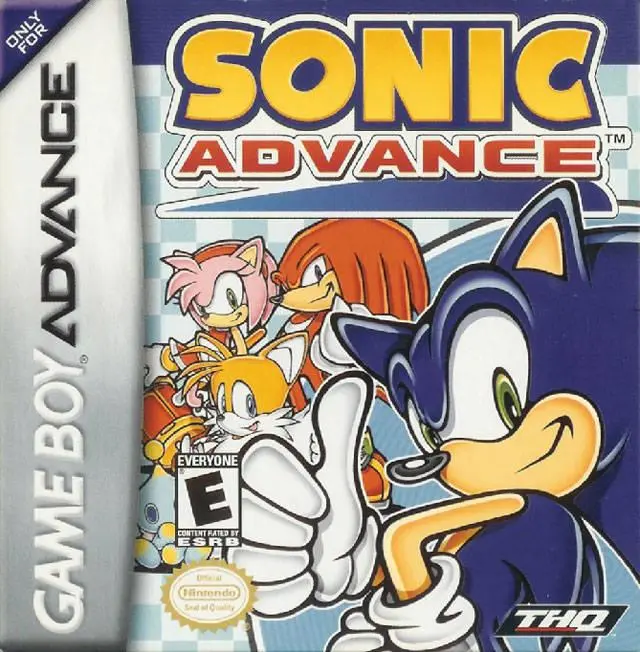
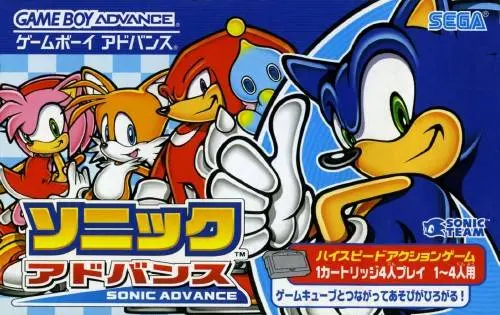
North American box.European box.Japanese box.Back of the North American box.Back of the European box.Back of the Japanese box.North American cartridge.Japanese cartridge.The English logo.The Japanese logo.A Chao.Egg X in the X-Zone.A loop in Neo Green Hill.Freeing the animals.Secret Base.Ice Mountain.Angel Island.Egg Rocket.Mecha Knuckles.Chao Hunt.Single-Pak multiplayer.The Egg Hammer Tank.
Sonic Advance proved Sonic could thrive on Nintendo hardware and gave Sega a handheld partner for the next decade. Dimps made the two Advance sequels, the Sonic Rush games and the handheld versions of later Sonics.
Releases and re-releases
Game Boy Advance (Japan)20 December 2001 – Released the same day as Sonic Adventure 2: Battle.
Game Boy Advance (North America)February 2002 – Co-published by THQ.
Game Boy Advance (Europe)8 March 2002 – UK price £34.99.
SonicN (N-Gage)7 October 2003 – Nokia’s version, without multiplayer.
Budget reissue (Japan)17 June 2004 – ¥3,800.
GBA double packs2005 – Paired in separate packs with Sonic Battle, Sonic Pinball Party or ChuChu Rocket!
Mobile and Android2011 – Gameloft’s phone version worldwide; Sega’s Android version in Japan on 25 November.
Wii U Virtual Console (Japan)18 February 2015 – The GBA original.
How it is remembered
Official Nintendo Magazine placed it 75th in its 2009 list of the greatest Nintendo games and called it the best Sonic since the Mega Drive. GamesRadar ranked it 13th among Sonic games in 2017 and USgamer sixth. Commentators have also pointed to its bigger significance: Sega and Nintendo went on to work together on F-Zero GX and, in 2007, to put Sonic and Mario in the same game.
Where to play it today
Outside Japan, the original cartridge is the only official way to play; Japan also got a Wii U Virtual Console release in February 2015.
Sales & reviews
Sales
In the United States alone it sold 1.21 million copies, by the figures Wikipedia and Sonic Retro cite, and it had taken US$36 million there by August 2006. That made it the twelfth best-selling game launched on the Game Boy Advance, Nintendo DS or PSP in the US between January 2000 and August 2006. We have not found reliable figures for Japan or Europe.
1.21mCopies sold in the US
$36mUS earnings by August 2006
86%Sega Retro’s average of 24 reviews
96%Total Advance, UK
Reception and review scores
Period reviews from Sega Retro’s index of magazine scans, with scores converted to percentages where needed.
Total AdvanceUK · issue 26 · 2002
96%
Consoles +France · February 2002 (Japanese version)
95%
GBXUK · March 2002
93%
Game Play 128France · May 2002
93%
CubeUK · issue 4 · March 2002
91%
AdvanceUK · spring 2002
91%
Nintendo Official MagazineUK · April 2002
90%
HyperAustralia · April 2002
90%
GameProUS · March 2002 (converted)
85%
Nintendo PowerUS · February 2002 (converted)
84%
Electronic Gaming MonthlyUS · March 2002 (converted)
77%
NGC MagazineUK · March 2002
75%
MAN!ACGermany · April 2002
70%
Critics agreed it was the best-looking 2D Sonic yet. EGM and Extended Play both said so outright, Game Informer rated it above the Mega Drive games for looks, and GameSpot and Nintendo World Report praised the detail and the anime-style animation. IGN liked the new ideas such as grinding and felt Sonic played better on the GBA than on the Mega Drive.
The complaints were about size and difficulty. Several reviewers thought it far too short, EGM found the multiplayer thin, GameSpot disliked the Special Stages, and Extended Play reckoned seasoned players would finish it at the first attempt. The N-Gage version fared worse, marked down for its frame rate and its tall screen.
Honours
Official Nintendo Magazine · 200975th greatest Nintendo gameFrom the magazine’s list of the greatest Nintendo games.
GamesRadar · 201713th best Sonic gameIn its ranking of the series.
USgamer · 20176th best Sonic gameSingled out for its gorgeous graphics.
Reader reviews
No reader reviews yet. Played it? Give it a score out of 10 and tell other fans what you think.
Every fact on this page was checked against the sources below. Sonic Retro and Sega Retro are linked through the Wayback Machine copies we read (the live sites sit behind a bot check).
To provide the best experiences, we use technologies like cookies to store and/or access device information. Consenting to these technologies will allow us to process data such as browsing behavior or unique IDs on this site. Not consenting or withdrawing consent, may adversely affect certain features and functions.
Functional
Always active
The technical storage or access is strictly necessary for the legitimate purpose of enabling the use of a specific service explicitly requested by the subscriber or user, or for the sole purpose of carrying out the transmission of a communication over an electronic communications network.
Preferences
The technical storage or access is necessary for the legitimate purpose of storing preferences that are not requested by the subscriber or user.
Statistics
The technical storage or access that is used exclusively for statistical purposes.The technical storage or access that is used exclusively for anonymous statistical purposes. Without a subpoena, voluntary compliance on the part of your Internet Service Provider, or additional records from a third party, information stored or retrieved for this purpose alone cannot usually be used to identify you.
Marketing
The technical storage or access is required to create user profiles to send advertising, or to track the user on a website or across several websites for similar marketing purposes.

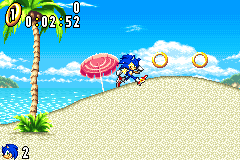 Neo Green Hill ZoneActs 1–2 · boss: Egg Hammer TankA beach full of umbrellas and deckchairs, then a downhill road packed with speed boosters. The only zone with no bottomless pits.
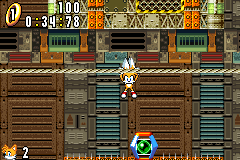 Secret Base ZoneActs 1–2 · boss: Egg PressAn Eggman factory with ziplines, hooks, pressurised pipes and vats of molten metal, owing a lot to Sonic 2’s Metropolis.
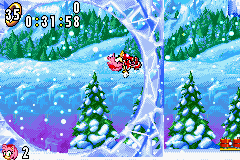 Ice Mountain ZoneActs 1–2 · boss: Egg SpiderSnow on top and long stretches underwater below. Air lasts 18 seconds, with no warning chime until the final countdown.
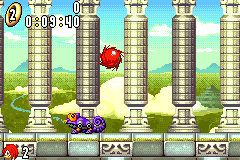 Angel Island ZoneActs 1–2 · boss: Mecha KnucklesNamed after Sonic 3’s jungle but closer to Sky Sanctuary: overgrown ruins, bouncy clouds and old machines you power by running on them.
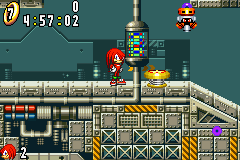 Egg Rocket ZoneOne act · a race against the clockBoard the rocket and a five-minute timer starts. Reach each stage before it separates and the clock resets, three times over.
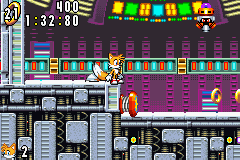 Cosmic Angel ZoneOne act · boss: Egg SnakeThe rocket’s destination, a space station that flips gravity and throws more pits and Badniks at you than anywhere else. The hardest stage in the game.
 Sonic the HedgehogPlayable hero
 Miles “Tails” ProwerPlayable
 Knuckles the EchidnaPlayable
 Amy RosePlayable for the first time in a classic-style 2D Sonic
 ChaoTiny Chao Garden
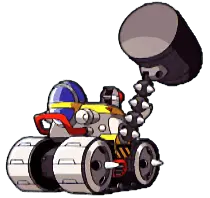 Egg Hammer TankNeo Green HillEggman’s opening machine.
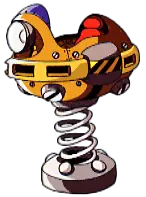 Egg PressSecret BaseFought among the factory machinery.
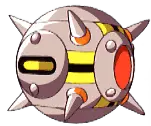 Egg BallCasino ParadiseA casino-themed machine.
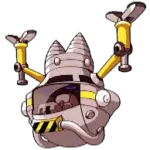 Egg SpiderIce MountainWaits at the end of the ice caves.
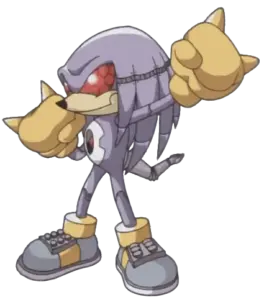 Mecha KnucklesAngel IslandA robot Knuckles.
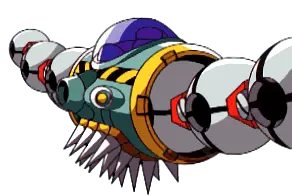 Egg SnakeCosmic AngelThe space station’s guardian.
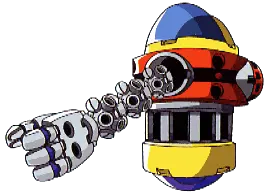 Egg XX-ZoneThe new machine at the end of the boss rush, after two remixed classics.
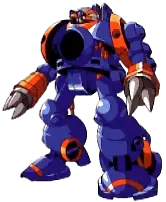 Super Egg RobotThe MoonThe true final boss, fought by Super Sonic.